
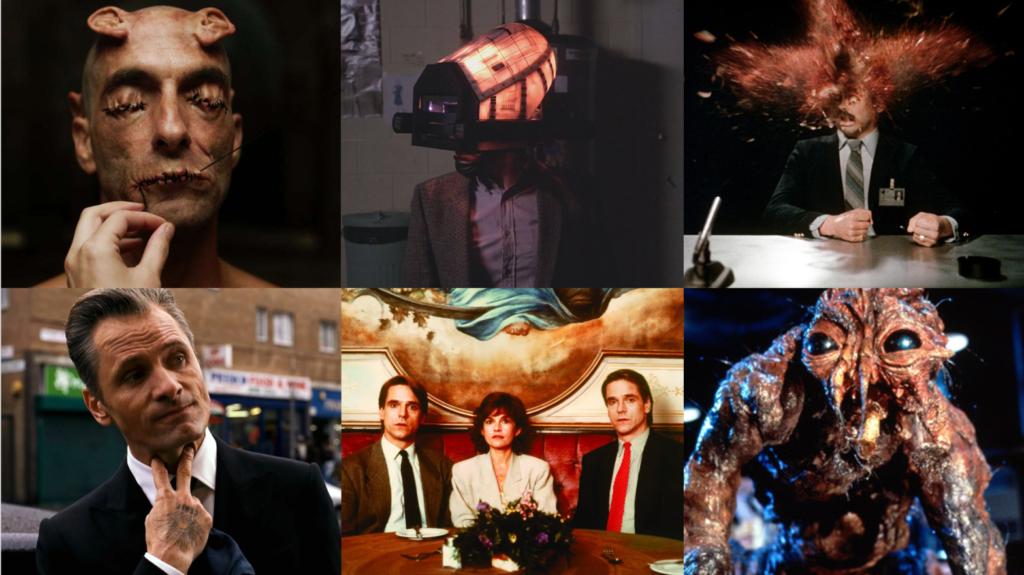
There are filmmakers who entertain us, filmmakers who challenge us… and then there are filmmakers who reshape the way we understand our own flesh. David Cronenberg belongs to the last category — not merely a director, but an anatomist of human fear, a philosopher of the wound, a poet of mutation.
And though he still walks among us, still creates, still dreams in viscera and chrome, it feels necessary — almost urgent — to speak of him the way one speaks of someone whose presence has already altered the landscape forever.
To remember him now.
The Prophet of the New Flesh
Cronenberg did not invent horror.
He made it intimate.
While traditional horror externalized fear into monsters, demons, and killers lurking in the dark, Cronenberg turned the camera inward. In his cinema, the monster is the body itself — unreliable, evolving, traitorous. The terror lies not in what hunts us, but in what we are becoming.
From the parasitic invasions of Shivers to the surgical psychosexual nightmares of Dead Ringers, his work insists on a simple, devastating truth:
The body is not a stable home. It is an event.
In Videodrome, flesh merges with broadcast signal. Technology ceases to be a tool and becomes an infection — a hallucination that rewrites biology itself. “Long live the new flesh,” the film proclaims, not as celebration, but as surrender.
And surrender we do.
Cinema That Bleeds
The term body horror follows Cronenberg like a medical diagnosis — accurate, but insufficient.
Yes, there are the erupting pustules of Rabid.
Yes, there is the grotesque metamorphosis of The Fly.
Yes, there are organic game pods and spinal ports in eXistenZ.
But beneath the mutations lies something quieter and far more tragic: the idea that identity itself is unstable — that our minds are not separate from our tissue, but subject to the same decay, invasion, and transformation.
In The Brood, trauma becomes literalized as monstrous offspring. In Crash, desire fuses with injury, turning car wreckage into erotic ritual. Pain becomes language. Flesh becomes memory.
The Elegance of Decay
Later works would see Cronenberg shedding visible mutation in favor of psychological incision.
A History of Violence and Eastern Promises replace erupting bodies with erupting identities. Violence still transforms — it simply does so beneath the skin. The human body remains central, even when it is not visibly breaking apart.
And yet, in Crimes of the Future, he returned to surgical performance and evolutionary dread, as though reminding us that the questions never left:
What is the body for?
What is pain becoming?
What will we look like when adaptation finishes its work?
While He Is Still Here
To eulogize someone still living is not to mourn them — it is to acknowledge the permanence of their influence before absence forces us to.
Cronenberg taught us that horror is not the violation of the body, but its inevitability. That transformation is not a tragedy, but a process already underway. That the future will not arrive cleanly — it will arrive wet, invasive, and alive.
His films did not merely imagine the merging of flesh and machine, trauma and form, sex and damage — they prepared us for it.
And somewhere, even now, he is still dreaming of new anatomies.
Long live the new flesh.
1970s
- 1969 – Stereo
- 1970 – Crimes of the Future
- 1975 – Shivers
- 1977 – Rabid
- 1979 – Fast Company
- 1979 – The Brood
1980s
- 1981 – Scanners
- 1983 – Videodrome
- 1983 – The Dead Zone
- 1986 – The Fly
- 1988 – Dead Ringers
1990s
- 1991 – Naked Lunch
- 1993 – M. Butterfly
- 1996 – Crash
- 1999 – eXistenZ
2000s
- 2002 – Spider
- 2005 – A History of Violence
- 2007 – Eastern Promises
2010s
- 2011 – A Dangerous Method
- 2012 – Cosmopolis
- 2014 – Maps to the Stars
2020s
- 2022 – Crimes of the Future
- 2024 – The Shrouds