
The Rise of Cosmic Horror in Modern Cinema
Cosmic horror has always occupied a strange corner of the genre. Unlike traditional horror, which focuses on monsters, killers, or supernatural forces that can be confronted or defeated, cosmic horror is rooted in something far more unsettling: the idea that humanity is insignificant in a vast, indifferent universe. It is horror born from existential dread rather than immediate danger, from the terrifying possibility that the universe is not only unknowable—but also uncaring.
The foundation of cosmic horror in modern culture can be traced directly to the works of H. P. Lovecraft. Through stories such as The Call of Cthulhu, The Colour Out of Space, and At the Mountains of Madness, Lovecraft introduced readers to ancient entities, forbidden knowledge, and the terrifying notion that reality itself might be far stranger and more hostile than humanity could ever comprehend. While these ideas were once mostly confined to literature, cinema has increasingly embraced cosmic horror in recent decades, bringing its unsettling philosophy to a broader audience.
The Difficulty of Adapting Cosmic Horror
For many years, cosmic horror was considered difficult—if not impossible—to translate effectively to film. Lovecraft’s stories often rely heavily on atmosphere, suggestion, and the idea of indescribable entities. When the horror comes from something beyond human understanding, showing it on screen can sometimes ruin the mystery.
However, filmmakers eventually discovered that the key to cosmic horror on screen wasn’t necessarily the creature itself—it was the loss of control and understanding experienced by the characters.
One of the earliest films to capture this feeling successfully was The Thing, directed by John Carpenter. While often categorized as a sci-fi horror film, The Thing contains many elements of cosmic horror: an alien organism that cannot be understood, paranoia among isolated humans, and the gradual realization that survival might be impossible. The creature itself is terrifying, but the real horror lies in the fact that humanity is completely unequipped to deal with it.
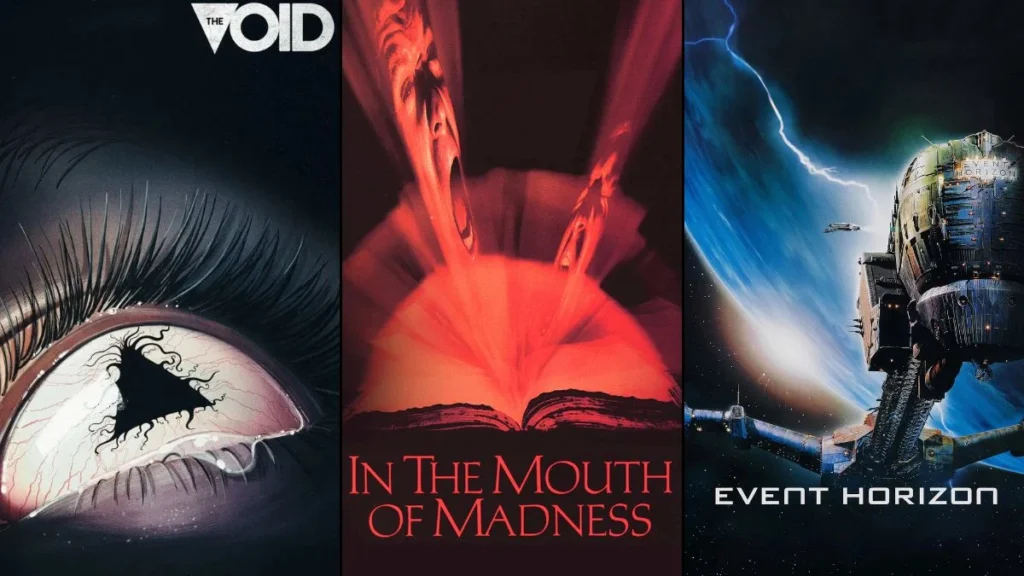
Similarly, In the Mouth of Madness, also directed by Carpenter, dives even deeper into Lovecraftian territory. The film explores the collapse of reality itself as ancient forces seep into the modern world through fiction and madness.
The Modern Revival of Cosmic Horror
In the last decade, cosmic horror has experienced a remarkable resurgence in film. Directors have begun experimenting with slower, more atmospheric storytelling that allows existential dread to unfold gradually.
One of the most striking modern examples is The Void, directed by Steven Kostanski and Jeremy Gillespie. The film blends Lovecraftian concepts with practical effects and cult imagery, placing characters inside a hospital surrounded by hooded figures and otherworldly creatures. As the story unfolds, it becomes clear that the situation extends far beyond anything the characters can understand.
Another standout entry is Annihilation, directed by Alex Garland. Rather than focusing on monstrous entities, the film explores cosmic horror through transformation and incomprehensible phenomena. The mysterious zone known as “The Shimmer” slowly alters biology, physics, and perception itself, creating a dreamlike nightmare where the rules of reality no longer apply.
Perhaps the most direct modern Lovecraft adaptation is Color Out of Space, starring Nicolas Cage. Based on Lovecraft’s short story, the film centers on a meteorite that lands near a rural farm, releasing an alien force that mutates the environment and the people who live there. The horror is not just physical—it’s cosmic, incomprehensible, and unstoppable.
Cosmic Horror in the Age of Existential Anxiety
The renewed interest in cosmic horror may not be accidental. Modern audiences live in a time filled with uncertainty—global crises, rapid technological change, and a growing awareness of humanity’s fragile place in the universe. Cosmic horror taps into these anxieties by confronting viewers with the possibility that humanity may not be the center of anything.
In many ways, cosmic horror reflects the unsettling truths revealed by modern science. The observable universe contains billions of galaxies, each filled with billions of stars. Against that scale, humanity becomes almost microscopic.
This perspective—once explored primarily in weird fiction—now resonates deeply with contemporary audiences.
The Future of Cosmic Horror
As filmmakers continue to experiment with tone, pacing, and visual storytelling, cosmic horror is likely to evolve even further. Advances in practical effects and digital technology make it easier than ever to depict strange worlds, alien entities, and reality-bending phenomena.
Yet the true power of cosmic horror has never come from visual spectacle alone. Its strength lies in the ideas beneath the surface: the fear of the unknown, the fragility of human understanding, and the chilling possibility that some truths are better left undiscovered.
In the end, cosmic horror reminds us of something deeply uncomfortable—that the universe may not care about us at all.
And sometimes, that thought is far more terrifying than any monster.