
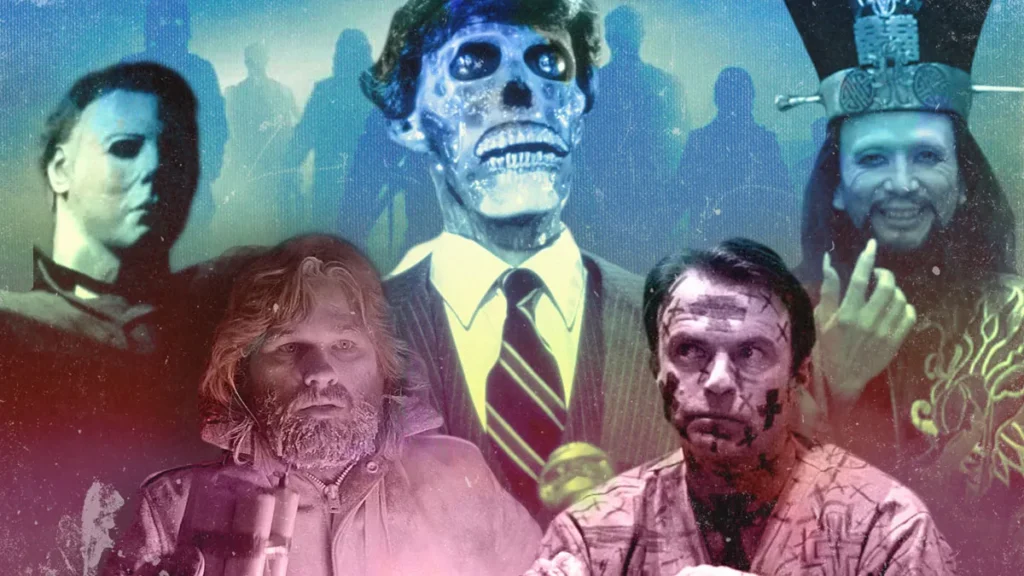
The Cinema of John Carpenter: Synths, Paranoia, and the End of the World
There are directors who define a genre, and then there are directors who quietly reshape the entire language of cinema. John Carpenter is one of those rare filmmakers whose work feels both deceptively simple and endlessly influential. His films are stripped down, efficient, and often bleak—but beneath their surface lies a worldview defined by paranoia, cosmic dread, and the unsettling realization that the systems meant to protect us are often powerless against the unknown.
Carpenter’s cinema is not just horror. It is apocalypse told through synthesizers and widescreen compositions.
The Birth of a Minimalist Master
Carpenter first caught the world’s attention with Halloween, a film that would permanently alter the trajectory of horror cinema. With its minimalist storytelling, haunting piano-driven score, and the silent presence of Michael Myers, the film helped define the modern slasher.
But what makes Halloween so effective is not the violence—it is the emptiness. Suburban streets become quiet hunting grounds. Evil appears without explanation, motivation, or moral logic. Carpenter removes the comforting idea that horror must make sense.
The monster simply exists.
Paranoia in the Snow
Few films capture existential terror quite like The Thing. Initially misunderstood upon release, it is now widely regarded as one of the greatest horror films ever made.
Set in an isolated Antarctic research station, the story revolves around an alien organism capable of perfectly imitating any living being. Identity dissolves. Trust becomes impossible. Friendship becomes a liability.
What makes The Thing so enduring is its brutal simplicity: anyone could already be the monster.
Combined with revolutionary practical effects and Carpenter’s hypnotic synthesizer score, the film became a defining work of paranoia-driven horror.
Horror Beyond the Slasher
While many associate Carpenter with slashers, his filmography is remarkably diverse.
In The Fog, he channels classic ghost stories through a coastal town haunted by its past.
In Prince of Darkness, physics and theology collide as scientists confront an ancient cosmic evil.
In In the Mouth of Madness, reality itself begins to collapse under the influence of forbidden fiction.
These films share a common theme: the universe is older, stranger, and more hostile than we can comprehend.
Carpenter’s horror rarely offers salvation. At best, his characters survive long enough to understand what they are facing.
The Outsiders and the Antiheroes
Carpenter’s protagonists are rarely traditional heroes.
They are criminals, drifters, skeptics, and reluctant survivors.
Consider the eyepatch-wearing outlaw Snake Plissken in Escape from New York, a cynical antihero navigating a dystopian Manhattan prison. Or the blue-collar laborer played by Roddy Piper in They Live, who discovers that society is secretly controlled by alien elites disguised as humans.
Carpenter’s films are populated by people on the margins—characters who instinctively distrust authority and institutions. In many cases, they are right to do so.
The Music of the Apocalypse
Another defining element of Carpenter’s work is something few directors attempt themselves: he composes the music for many of his films.
His synthesizer scores—minimal, rhythmic, and haunting—have become iconic. The pulsing themes of Halloween, The Thing, and Escape from New York create atmosphere with just a handful of notes.
These soundtracks helped shape the sound of modern horror and continue to influence electronic musicians and film composers today.
In Carpenter’s world, the end of the world often arrives to a steady electronic heartbeat.
The Carpenter Legacy
Today, the influence of John Carpenter can be felt everywhere—from horror cinema to video games, from synthwave music to modern television.
Filmmakers frequently cite him as a major inspiration, and films like The Thing and Halloween have become cornerstones of the genre.
But perhaps the greatest testament to his legacy is how modern his films still feel. Their themes—corporate control, institutional failure, paranoia, and unseen forces manipulating society—remain disturbingly relevant.
Carpenter once described his worldview as simple:
The world is a dangerous place, and sometimes the monsters win.
And in the cinema of John Carpenter, that truth echoes through empty streets, frozen wastelands, and the steady pulse of a synthesizer.