
Isolation, Paranoia, and Perfect Horror: Revisiting The Thing
Few films have undergone a cultural transformation as dramatic as The Thing, directed by John Carpenter. When it premiered in 1982, the film was met with mixed-to-negative reviews and struggled at the box office. Critics found it excessively bleak, grotesque, and nihilistic. Audiences at the time were gravitating toward optimistic science fiction like E.T. the Extra-Terrestrial, and Carpenter’s cold, merciless vision of alien contact felt like the exact opposite of what viewers wanted.
Yet time has a way of revealing the true nature of things.
Today, The Thing is widely regarded as one of the greatest horror films ever made—an achievement in practical effects, psychological tension, and pure cinematic dread. Its influence can be seen across decades of horror, science fiction, and video games, and its central themes of paranoia and identity feel more relevant now than ever.
The Origins of the Story
The film is based on the 1938 novella Who Goes There? by science fiction writer John W. Campbell. The story had already been adapted once before in the 1951 film The Thing from Another World, but Carpenter’s version returned more faithfully to the source material.
Instead of portraying the alien as a humanoid monster stalking humans from the outside, the story centers on a far more terrifying concept: an organism that can perfectly imitate any lifeform it consumes.
This creature does not hunt like a predator.
It replaces.
A Frozen Stage for Paranoia
The story takes place in one of the most isolating environments imaginable: an American research station in Antarctica. The opening moments immediately establish a mystery when a Norwegian helicopter pursues a dog across the frozen landscape, firing rifles in apparent desperation.
The dog eventually reaches the American base, where the crew—led by helicopter pilot R.J. MacReady, played by Kurt Russell—takes the animal in without understanding what is truly happening.
Soon they discover the horrifying truth: the dog is not a dog.
It is the Thing.
Once inside the base, the alien organism begins assimilating members of the crew, perfectly replicating their appearance, voice, and memories. The problem becomes immediately clear: no one can tell who is still human.
In this environment, the creature doesn’t just kill—it destroys trust itself.
The Horror of Uncertainty
Unlike many horror films where the monster is clearly identifiable, The Thing builds its tension through uncertainty. Every character could potentially be infected. Any conversation might be happening between two impostors. Even the protagonist cannot be completely trusted.
The crew slowly begins to unravel psychologically as suspicion replaces cooperation. Friendships dissolve. Accusations fly. Guns are drawn. The men are trapped together in an environment where escape is impossible and trust is fatal.
This dynamic transforms the film into a kind of horror chess game, where survival depends on identifying the monster before it replaces everyone.
But the creature is patient.
It doesn’t need to rush.
Rob Bottin and the Art of Practical Terror
One of the most celebrated aspects of The Thing is its groundbreaking practical effects, designed primarily by special effects artist Rob Bottin.
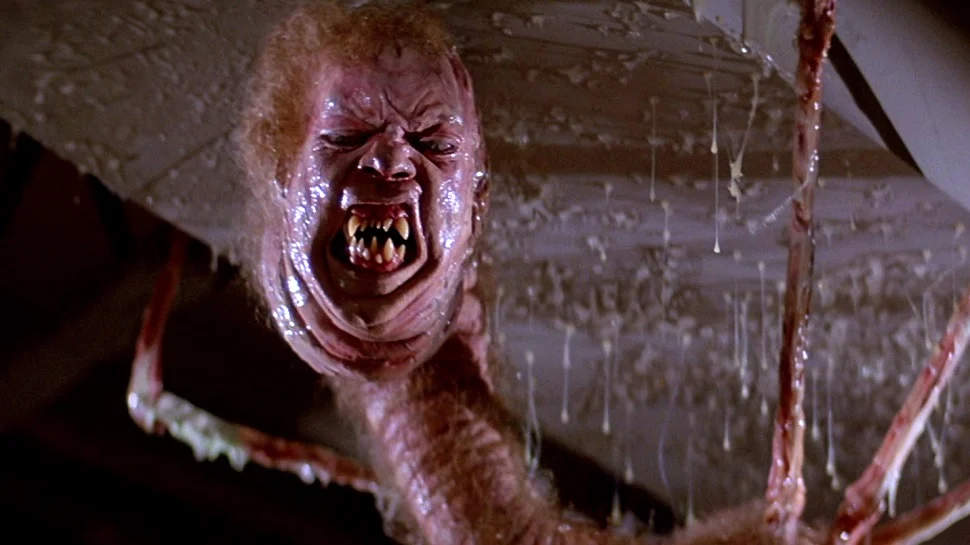
The creature in The Thing does not have a single fixed form. Instead, it exists as a constantly mutating biological nightmare—half-finished imitations, erupting limbs, screaming mouths, and grotesque anatomical rearrangements.
Some of the most famous scenes in horror history come directly from Bottin’s work:
- The shocking kennel sequence, where the infected dog erupts into a mass of tendrils and teeth.
- The defibrillator scene, where a man’s chest splits open into a monstrous jaw.
- The unforgettable moment when a severed head sprouts spider-like legs and attempts to escape across the floor.
These effects remain astonishing even decades later because they are tangible. They occupy real physical space, giving the film a visceral quality that digital effects often struggle to replicate.
The monster feels wet, alive, and horrifyingly organic.
A World Without Hope
Perhaps the most striking aspect of The Thing is its relentless bleakness.
Many horror films provide audiences with relief—an escape, a hero, or a final victory. Carpenter offers none of these comforts. Instead, he constructs a narrative where the characters are fighting an enemy that is not only stronger than they are, but also more patient and adaptable.
The film constantly reminds us of the stakes: if the creature escapes Antarctica, it could assimilate the entire human population within a matter of years.
Humanity itself becomes fragile.
The only way to stop the creature may be total annihilation.
The Legendary Ending
The final moments of The Thing remain one of the most debated endings in horror cinema. After the base is destroyed in a desperate attempt to stop the creature, MacReady and fellow survivor Childs sit together in the freezing ruins, sharing a bottle of whiskey as the Antarctic cold slowly closes in.
One question hangs over the scene:
Is one of them the Thing?
The film never answers this question, and that ambiguity is precisely what makes the ending so powerful. The uncertainty mirrors the central theme of the entire story—trust has been completely destroyed.
Even survival becomes meaningless when identity itself can no longer be confirmed.
From Failure to Masterpiece
Upon its release, The Thing struggled commercially and was criticized for its graphic violence and pessimistic tone. Over the following decades, however, the film underwent a dramatic reevaluation.
Today, it is widely considered a masterpiece of horror filmmaking and one of the defining works of Carpenter’s career.
Its influence can be seen in countless films, television shows, and video games that explore themes of paranoia, hidden enemies, and identity loss. The film has also become a touchstone for practical effects artists and horror directors alike.
What was once dismissed as excessive has become a gold standard for the genre.
The Enduring Fear of the Unknown
At its core, The Thing taps into one of humanity’s deepest fears: the idea that the enemy may already be among us.
Not as an obvious monster.
But as a perfect imitation.
In a world where appearances cannot be trusted and certainty disappears, the film reminds us of a terrifying possibility: sometimes the greatest horror is not the creature outside the door, but the one sitting quietly beside you.
And in the frozen silence of Antarctica, that realization is enough to end the world.