
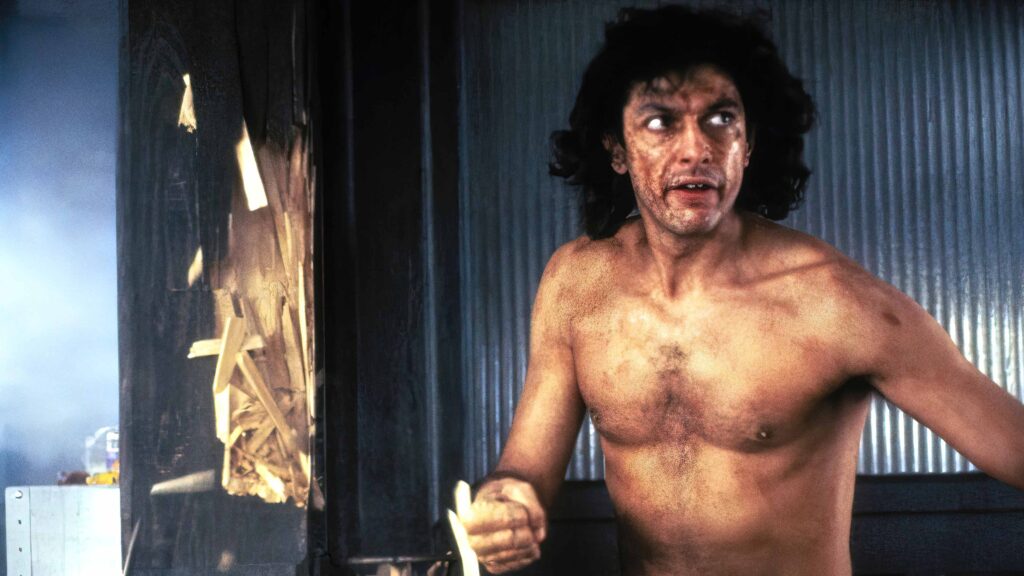
The Tragic Body Horror of The Fly
Few horror films manage to be both deeply disturbing and profoundly heartbreaking, but The Fly stands as one of the rare exceptions. Directed by David Cronenberg and starring Jeff Goldblum and Geena Davis, the film is often remembered for its grotesque transformation scenes and groundbreaking practical effects. Yet beneath the surface of melting flesh and grotesque mutation lies something far more powerful.
At its core, The Fly is not simply a monster movie.
It is a tragedy about the slow destruction of a human being.
A Classic Story Reborn
Cronenberg’s film is a remake of The Fly, which itself was based on the short story The Fly by French author George Langelaan. While the earlier version focused more on the shock of a human head appearing on a fly’s body, Cronenberg radically expanded the concept into something far darker and more intimate.
Instead of a simple accident that instantly transforms the scientist, Cronenberg chose a more horrifying path: a gradual, unstoppable mutation.
The horror unfolds slowly, allowing the audience to witness every painful stage of the transformation.
The Rise of Seth Brundle
The film follows brilliant but eccentric scientist Seth Brundle, played with remarkable energy by Jeff Goldblum. Brundle has invented a revolutionary teleportation device that can transport objects instantly between two pods.
When journalist Veronica Quaife, played by Geena Davis, begins documenting his experiments, a romantic relationship develops between the two. For a brief moment, the film almost feels like a quirky romantic drama. Brundle is awkward, brilliant, and full of optimism about the possibilities of his invention.
But everything changes when he decides to test the teleportation machine on himself.
Unbeknownst to him, a housefly enters the teleportation pod with him during the experiment.
The machine cannot distinguish between the two life forms.
It merges them.
The Slow Transformation
What makes The Fly so effective is that the transformation does not happen immediately. At first, Brundle believes the experiment has improved him. He becomes stronger, faster, and filled with manic energy. He believes he has somehow purified the human body.
But soon the changes begin.
A strange hair appears on his back. His skin becomes sensitive. His teeth and fingernails begin to fall out. His body slowly begins to deteriorate as the alien DNA inside him takes control.
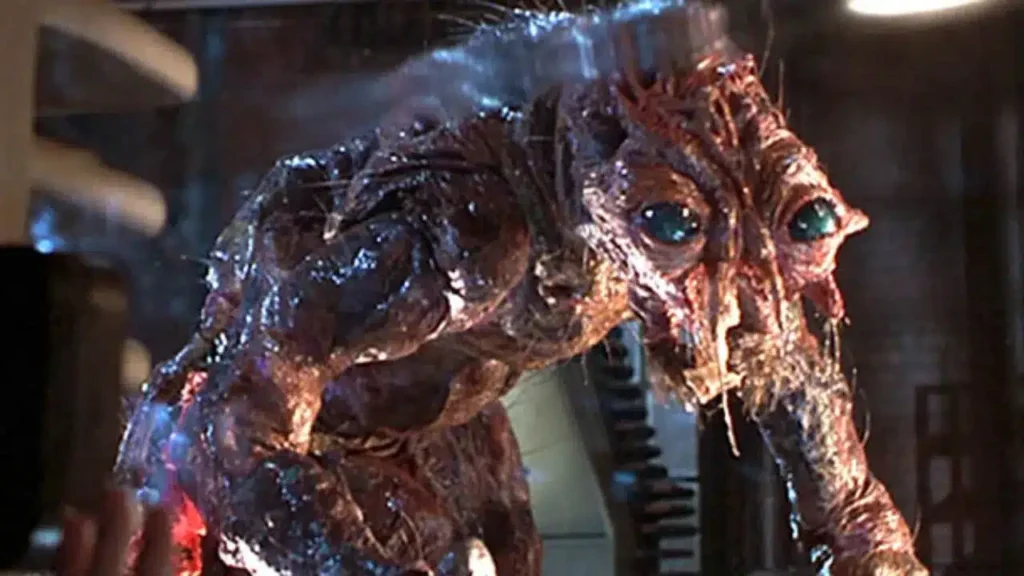
Brundle begins documenting the process himself, eventually realizing that he is becoming something else entirely. He names the creature he is turning into “Brundlefly.”
This gradual decay is what elevates the film beyond simple horror. The audience is forced to watch a brilliant man slowly lose control of his own body.
The monster is not attacking him.
The monster is him.
Practical Effects That Still Shock
The transformation scenes in The Fly are legendary, thanks largely to the work of makeup and effects artist Chris Walas, who won an Academy Award for his work on the film.
Rather than relying on sudden shock moments, the effects are designed to illustrate a progressive biological collapse. Each stage of Brundle’s mutation introduces new deformities:
- Skin lesions and abnormal hair growth
- Fingernails and teeth falling out
- Disfigured limbs and insect-like movements
- The eventual emergence of the monstrous Brundlefly creature
These effects remain impressive decades later because they are practical and tactile. The transformation feels painfully real, as if the viewer is witnessing a disease rather than a supernatural event.
A Metaphor for Disease and Decay
Many critics and audiences have interpreted The Fly as a metaphor for terminal illness. The film was released during the 1980s, a period when the AIDS epidemic was spreading fear and uncertainty throughout society. While Cronenberg has never explicitly confirmed this interpretation as his intention, the parallels are difficult to ignore.
Brundle’s transformation mirrors the experience of someone suffering from a degenerative disease:
- The early denial that anything is wrong
- The gradual appearance of symptoms
- The increasing isolation from loved ones
- The loss of physical control
- The final acceptance that the body has turned against itself
One of the most devastating moments in the film occurs when Brundle describes his condition as “a disease with a purpose.”
It is a line that captures the terrifying idea that nature itself may be indifferent to human suffering.
The Tragedy of Love
Despite all the grotesque imagery, the emotional core of The Fly is the relationship between Seth Brundle and Veronica Quaife.
Veronica watches helplessly as the man she loves slowly disappears. She witnesses the transformation, not as an abstract horror, but as a personal loss. The man she fell in love with is still there somewhere—but his body and mind are being consumed by something alien.
In many ways, The Fly functions as a tragic love story disguised as a horror film. The emotional stakes are not about stopping a monster from destroying the world. They are about watching someone you love become unreachable.
By the time the final act arrives, the horror has shifted from physical disgust to emotional devastation.
One of the Saddest Endings in Horror
The climax of The Fly delivers one of the most tragic endings in the genre. After Brundle fully transforms into a grotesque hybrid creature, the last remnants of his humanity emerge in a desperate plea for release.
The monster that once was Seth Brundle silently begs Veronica to end his suffering.
What follows is not a triumphant victory over evil.
It is an act of mercy.
A Masterpiece of Body Horror
More than three decades after its release, The Fly remains one of the greatest examples of body horror ever created. It perfectly represents the themes that define the work of David Cronenberg: the fragility of the human body, the instability of identity, and the terrifying possibility that evolution may not care about our survival.
But what truly sets the film apart is its humanity.
Beneath the grotesque mutations and unforgettable special effects lies a simple, devastating truth: sometimes the most horrifying transformation is watching a person disappear while their body remains behind.
And in The Fly, that transformation is impossible to forget.