
The Bleak Horror of The Texas Chain Saw Massacre
Few films in the history of horror have left an impact as raw, unsettling, and enduring as The Texas Chain Saw Massacre. Directed by Tobe Hooper, the film remains one of the most disturbing cinematic experiences ever created—not because of graphic violence, but because of its suffocating atmosphere of decay, madness, and hopelessness.
More than fifty years after its release, The Texas Chain Saw Massacre continues to haunt audiences with a kind of horror that feels almost documentary-like in its realism. It does not rely on elaborate mythology or supernatural threats. Instead, it presents something far more terrifying: human cruelty existing in plain sight, hidden within the forgotten corners of rural America.
A Film That Feels Too Real
One of the most unsettling aspects of The Texas Chain Saw Massacre is how real it feels. The film was produced on a relatively small budget, and its rough cinematography, harsh lighting, and chaotic editing create the impression that the audience is witnessing something that was never meant to be seen.
From the opening narration to the grainy images of decaying corpses under the Texas sun, the film establishes a tone of documentary realism. Viewers are not simply watching a horror movie—they feel as though they are witnessing the aftermath of a crime.
Hooper intentionally leaned into this aesthetic, creating a visual style that emphasized grime, heat, and discomfort. The Texas landscape becomes almost suffocating, filled with abandoned houses, animal bones, and rusting machinery.
It is a world that feels abandoned by civilization.
A Journey Into Isolation
The story follows a group of young friends traveling through rural Texas who decide to visit the grave of a relative after hearing reports of grave robbing in the area. Their journey eventually leads them down a dusty road toward a seemingly empty farmhouse.
What they find there is something far worse.
Inside the house lives a deeply disturbed family of cannibals, including the now-iconic killer Leatherface. Wearing masks made from human skin and wielding a roaring chainsaw, Leatherface has become one of horror cinema’s most recognizable figures.
But unlike many later slasher villains, Leatherface is not portrayed as a calculating monster. He is more like a terrified animal reacting violently to intruders in his home. His brutality is sudden, chaotic, and deeply unsettling.
In many ways, Leatherface is only one piece of a larger nightmare.
A Family of Monsters
The real horror of The Texas Chain Saw Massacre lies not just in Leatherface, but in the twisted family that surrounds him. These characters are grotesque reflections of a once-functioning household that has collapsed into insanity.
Among them is the manic hitchhiker who first introduces the audience to the family’s disturbing worldview, and the terrifying patriarch known as the Cook, whose sadistic enthusiasm turns the film’s final act into something resembling a nightmare dinner party.
Together, they represent a grotesque parody of the traditional American family.
The film suggests that isolation, economic decline, and generational violence have turned this household into something monstrous.
The Horror You Don’t See
Despite its reputation for brutality, The Texas Chain Saw Massacre is surprisingly restrained in terms of explicit violence. Much of the film’s horror comes from suggestion rather than graphic imagery.
The sound of a hammer striking bone.
The roar of a chainsaw echoing through an empty field.
The sight of furniture made from human remains.
Hooper understands that what the audience imagines can be far more disturbing than anything shown directly on screen. The film’s editing often cuts away from moments of violence at the exact moment they become unbearable, leaving the viewer to fill in the horrific details.
This approach contributes to the film’s almost unbearable tension.
A Portrait of Social Decay
While The Texas Chain Saw Massacre is often remembered simply as a slasher film, many critics have pointed out its deeper social commentary. Released during a time of economic anxiety and cultural disillusionment in the United States, the film reflects a world where traditional structures have collapsed.
The cannibal family were once slaughterhouse workers, now unemployed after modernization replaced human labor with machines. Their violence becomes a grotesque extension of the same industrial brutality that once defined their profession.
In this sense, the film portrays violence not as an isolated act of madness, but as something woven into the fabric of society itself.
The Final Escape
The film’s final sequence remains one of the most unforgettable endings in horror history. After enduring unimaginable terror, the lone survivor manages to escape the farmhouse and flee down the road, laughing and screaming in a state of total psychological collapse.
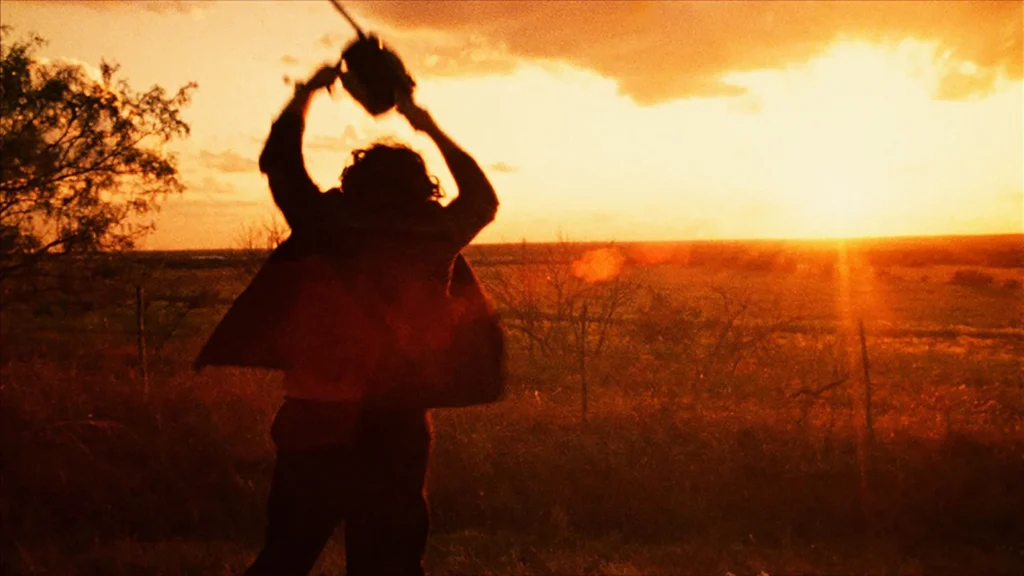
As she speeds away in the back of a passing truck, Leatherface remains behind, swinging his chainsaw wildly against the rising Texas sun.
It is not a moment of triumph.
It is simply the end of the nightmare—for now.
A Legacy of Pure Terror
Decades after its release, The Texas Chain Saw Massacre remains one of the most influential horror films ever made. It helped shape the slasher genre, inspired countless filmmakers, and introduced one of the most iconic villains in cinema.
But what truly sets the film apart is its tone. Unlike many horror movies that offer thrills or escapism, The Texas Chain Saw Massacre leaves viewers with something far more unsettling: the sense that the world it depicts could exist just beyond the edge of the highway, hidden behind a rusted gate and a dusty dirt road.
And somewhere in that forgotten place, the sound of a chainsaw might still be echoing through the heat.